 310-553-3055
 213-463-2100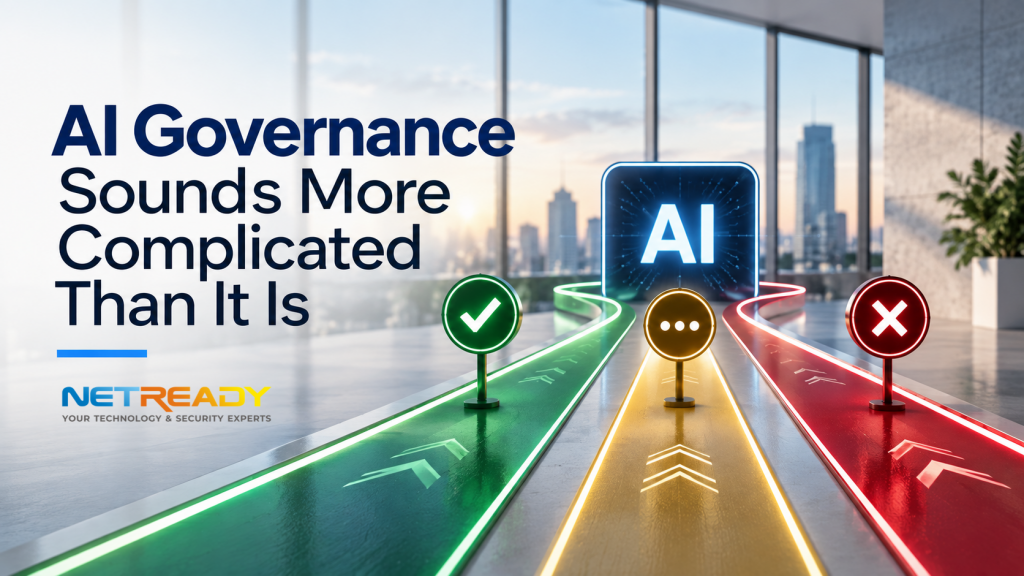
Over the past couple of years, I've had a lot of conversations with business leaders about AI.
Most of those conversations start with opportunity.
How can we use it?
Where can it save time?
Can Microsoft Copilot help our employees work more efficiently?
Which AI tools should we invest in?
Can we automate some of what we're doing today?
Those are good questions.
But there's another conversation that I think needs to happen alongside them.
How are we going to govern it?
Because implementing AI and governing AI are two very different things.
One is about what the technology can do.
The other is about deciding what it should do inside your organization.
And as AI becomes part of everyday business operations, that distinction is becoming increasingly important.
At Its Core, It's About Setting the Rules
When people hear "AI governance," I think they sometimes imagine a massive compliance program filled with policies, committees and restrictions.
It doesn't have to start that way.
At its core, AI governance is about establishing responsibility and boundaries around how your organization uses artificial intelligence.
Which AI platforms are approved?
What company information can be entered into them?
What information shouldn't be?
When does AI-generated work need human review?
Who is responsible for verifying its accuracy?
Can AI be used to make decisions involving customers or employees?
How do you evaluate a new AI tool before connecting it to company information?
Who is ultimately accountable for all of this?
Those aren't really technology questions.
They're business questions involving technology.
And that's an important distinction.
Buying an AI Tool Doesn't Answer Those Questions
Let's say a company decides to roll out Microsoft Copilot.
That's a technology decision.
The company still has to decide how Copilot will be used.
Maybe employees can use it to summarize meetings and draft documents.
But what about analyzing confidential client information?
What about HR documents?
Financial information?
Contracts?
Customer communications?
Can an employee rely on an AI-generated analysis without checking the source material?
Can AI-generated content be sent directly to a customer?
What happens when the AI gets something wrong?
The technology itself doesn't make all of those decisions for you.
Leadership does.
That's where governance comes in.
Good Governance Should Help People Use AI
One mistake businesses can make is treating AI governance as a long list of things employees aren't allowed to do.
Don't use this.
Don't upload that.
Don't connect this.
Don't trust that.
There certainly need to be boundaries.
But if your AI policy consists entirely of restrictions, you may miss the point.
The goal should be to help employees understand how to use AI appropriately and effectively.
Tell people which tools they can use.
Explain what information is appropriate to share.
Give them examples of good use cases.
Establish when human review is required.
Teach them how to verify AI-generated information.
Give them somewhere to go when they're unsure.
Good governance shouldn't make employees afraid to use AI.
It should give them the confidence to use it responsibly.
Someone Has to Own It
This is where I think AI creates an interesting challenge for many organizations.
Who owns AI?
Is it IT?
Cybersecurity?
Legal?
Compliance?
HR?
Operations?
Executive leadership?
The answer may be some combination of all of them.
IT can evaluate the technology and its integrations.
Cybersecurity can assess data exposure and access.
Legal and compliance can identify regulatory obligations.
HR may need to address employee use.
Business leaders understand the workflows where AI could create the most value.
But somebody still needs to coordinate those conversations.
Otherwise, it's very easy for AI decisions to happen independently throughout the organization.
Marketing chooses one platform.
Sales starts using another.
Operations connects something else.
An employee discovers a useful tool and signs up with a company email address.
Individually, each decision may seem small.
Collectively, the company may have very little visibility into how AI is actually being used.
Governance gives those decisions a framework.
AI Governance Is Also About the Data You Already Have
There's another piece of this that I think businesses sometimes overlook.
AI doesn't create your data governance problems.
It can expose them.
Imagine giving an AI assistant access to your company's Microsoft 365 environment.
The AI may be capable of finding, summarizing and connecting information much faster than an employee could manually.
That's incredibly useful.
But if employees already have access to files they shouldn't have access to, AI can make that existing problem much more visible.
A forgotten SharePoint folder.
An old permission group.
Sensitive documents available to too many people.
Files that were shared years ago and never reviewed.
AI can make information easier to find.
That's the feature.
But it also means businesses need to understand who can access what before making that information easier to discover.
Sometimes AI readiness starts with cleaning up the technology environment you already have.
Don't Forget About Accuracy
Security and privacy tend to dominate conversations about AI risk.
But there's another issue businesses need to govern:
Accuracy.
AI can produce an answer that sounds completely confident and still be wrong.
That matters when employees use it to create reports, summarize contracts, research regulations, analyze data or communicate with customers.
So, an AI governance plan should answer a simple question:
When does a human need to verify the work?
The answer probably isn't "everything."
If AI helps rewrite an internal email, the risk is relatively low.
If AI summarizes a contract, interprets a compliance requirement or produces information that will influence a financial decision, the stakes are very different.
Governance should recognize that difference.
Not every AI use case carries the same level of risk.
The Rules Will Have to Change
There's one more thing I'd tell any business developing an AI governance plan:
Don't expect to write it once.
The technology is changing too quickly.
New tools will appear.
Existing platforms will add capabilities.
Regulations will evolve.
Employees will discover new ways to use AI.
Your business itself will change.
A policy written today may not adequately address how your organization is using AI a year from now.
That's why governance needs to be a process rather than a document sitting somewhere on a shared drive.
Review it.
Update it.
Talk about it.
And make sure the people actually using the technology understand it.
AI Governance Isn't About Saying No
I've spent more than 25 years watching businesses adopt new technology.
There's almost always a period where the technology moves faster than the rules around it.
AI is no different.
AI is moving quickly, and businesses need to be thoughtful about how they keep pace.
Businesses should be looking for ways to improve productivity.
They should be asking where AI can make employees better at what they do.
But innovation and governance shouldn't be competing ideas.
They should happen together.
Because the businesses that get the most value from AI probably won't be the ones that simply adopt the most tools.
They'll be the ones that understand where AI belongs, what information it can access, how its work should be reviewed, and who is responsible for the decisions being made around it.
So, if your leadership team is having conversations about AI, I'd add one more question to the agenda:
Who's governing it?