 310-553-3055
 213-463-2100
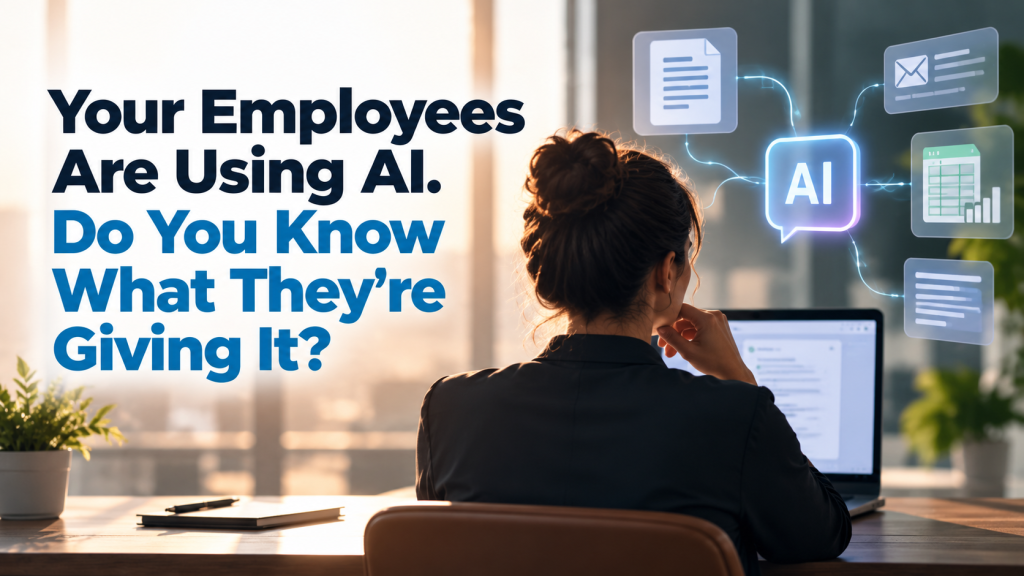
Somewhere in your company, an employee may be using AI right now.
Maybe they're asking it to improve an email.
Maybe they're summarizing meeting notes.
Maybe they're analyzing a spreadsheet.
Maybe they're uploading a customer document because they need a quick summary.
They're probably not trying to create a security problem.
They're trying to get their work done faster.
And that's why I think businesses need to look at employee AI use from two sides.
What is AI helping your employees accomplish?
And:
What are they giving AI in order to accomplish it?
Both matter.
The Task May Be Harmless. The Information May Not Be.
If an employee finds a way to turn an hour-long task into a 15-minute task, that's something I'd want to know about.
That could be a real opportunity for the business.
But consider what might be happening behind that productivity.
An employee asks AI to rewrite an email.
What was in the email?
Customer information? Pricing? Contract terms? An internal discussion?
Someone asks AI to summarize a document.
Was it a public report or a confidential customer agreement?
Someone uploads a spreadsheet for analysis.
What information was in those rows and columns?
The task itself may seem completely harmless.
The information being used to complete it may not be.
That's the distinction businesses need employees to understand.
Don't Make Employees Guess
Telling employees to "use AI responsibly" isn't enough.
What does that actually mean when someone is trying to finish a project on a Wednesday afternoon?
Employees need practical boundaries.
Which AI tools are approved?
What company information can be used with them?
What information shouldn't be entered?
When does AI-generated work need to be reviewed by a person?
And who should an employee ask when they're unsure?
The goal isn't to make AI difficult to use.
It's to make the right way to use it clear.
Otherwise, employees are left to make those decisions themselves.
Find Out What's Actually Happening
Before a business can create an effective AI strategy, it needs some visibility.
And I wouldn't start by sending out a survey.
I'd talk to people.
Sit down with employees from different parts of the organization and ask them to show you how AI has become part of their work.
You may discover an employee is putting information into an AI tool that you'd rather keep protected.
But you may also discover something completely different.
Someone may have found a way to save three hours every week on a repetitive task.
Someone else may have figured out a better way to organize information or complete a process.
Those are opportunities worth finding too.
And when you find a good use of AI, don't leave it with one employee.
Ask whether it can become a safe, repeatable process that others can benefit from.
That's when AI starts becoming a business capability instead of a collection of individual experiments.
You Don't Need to Have Everything Figured Out
AI is moving quickly, and I don't think businesses need to have every answer before they begin addressing how it's being used.
Start with what is happening inside your company today.
Understand where AI is providing value.
Understand where your information is going.
Then put practical rules around both.
For some businesses, figuring out who should own this process can be difficult. They may not have someone internally who is responsible for evaluating AI tools, protecting company information, and creating guidelines for employees.
If that's where your business is, Netready can help you develop a practical approach to AI that fits your organization, your people, and your data.
Because the goal isn't to keep AI out of your business.
It’s to understand how it’s being used so you can protect what matters and build on what works.