 310-553-3055
 213-463-2100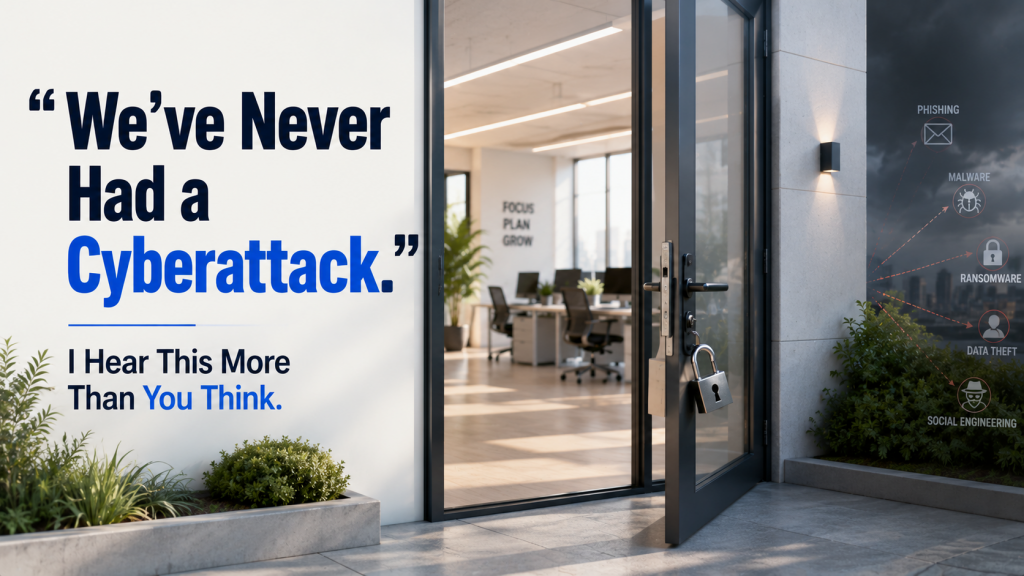
I've had some version of this conversation more times than I can count.
We're sitting down with a business owner or leadership team reviewing their cybersecurity environment.
We've identified areas that need attention. Maybe they're missing some basic protections altogether. Or maybe they need stronger endpoint protection, more advanced monitoring, better identity controls, employee security training, a vulnerability assessment, better backups, or additional safeguards around Microsoft 365.
Then comes the question:
"But we've never had a problem before. Do we really need to invest in all of this?"
I understand why business owners ask.
When you're deciding where to spend money, it's much easier to justify something you can immediately see.
Hire another salesperson and you can measure the revenue they generate.
Upgrade a piece of equipment and you can see the improvement in production.
Implement new software and maybe your team saves hours every week.
Cybersecurity is different.
When it's working well, sometimes the most visible result is that nothing happens.
And ironically, that's what can make it so difficult to justify.
"We've Never Been Breached" Isn't a Security Strategy
I've spent more than 25 years in cybersecurity, and one thing I've learned is that a quiet history doesn't necessarily tell you much about your future risk.
You can drive for years without getting into a car accident.
That doesn't make the seat belt unnecessary.
Businesses change constantly.
You add employees.
You adopt new applications.
You move data into the cloud.
Employees work remotely.
Vendors gain access to systems.
People leave the company.
AI tools enter the workplace.
And every one of those changes can alter your risk.
At the same time, cybercriminals aren't standing still either.
The techniques we were defending against five years ago aren't identical to what we're seeing today.
So, when someone tells me, "We've been fine for ten years," my concern isn't what happened during those ten years.
It's whether the business is prepared for what could happen tomorrow.
The Hardest Thing to Sell Is the Incident That Never Happened
This is one of the strange realities of working in cybersecurity.
For businesses that have already invested in cybersecurity, much of the value can be nearly invisible.
You don't get an email every morning saying:
"Good news. Your security controls stopped something bad from happening today."
A business owner doesn't necessarily see the thousands of malicious connection attempts blocked by a firewall.
They may never know that an employee almost clicked a phishing link but recognized it because of security awareness training.
They don't see every suspicious login that gets challenged or every endpoint alert that gets investigated before it becomes something bigger.
They just see another normal Tuesday.
Employees are working.
Customers are being served.
Email is running.
Systems are available.
Nothing happened.
That's the point.
Cybersecurity Isn't About Buying More Technology
This is also where I think the cybersecurity industry sometimes gets the conversation wrong.
The answer isn't to scare business owners into buying every security product available.
That's not good cybersecurity either.
The question should be:
What are we protecting, what could realistically happen to it, and what would that mean for the business?
If your email went down for two days, what would happen?
If someone gained access to an executive's Microsoft 365 account, what could they reach?
If ransomware encrypted your systems tomorrow morning, how quickly could you restore operations?
If sensitive customer information were stolen, who would you have to notify?
Would there be regulatory consequences?
Would your cyber insurance policy respond the way you expect it to?
How much revenue would you lose if employees couldn't work?
Those are business questions.
Cybersecurity controls are simply part of how we manage those risks.
The Cost of an Incident Isn't Just the Ransom
When people think about the financial impact of a cyberattack, they often think about ransomware payments.
That's only one possible expense.
An incident can mean forensic investigators, legal counsel, regulatory notifications, restoration work, lost productivity, business interruption, emergency IT expenses, customer communication, increased insurance costs, and potentially lost business.
Then there's something much harder to calculate:
Trust.
How much is it worth to have customers believe you can protect their information?
How much does it cost when they no longer do?
According to IBM's 2026 Cost of a Data Breach research, the global average cost of a breach is now roughly $5 million. AI-enabled malicious breaches cost organizations an average of $6 million.
Obviously, not every incident will cost millions of dollars.
But that's not really the point.
The question for a business owner is much simpler:
What would a serious cyber incident cost your business?
Start With Risk, Not Fear
I don't believe cybersecurity decisions should be made out of fear.
They should be made based on risk.
Not every business needs the same cybersecurity program.
A 20-person professional services firm doesn't have the same environment as a hospital, manufacturer, financial institution, or 500-person organization.
That's why I would rather show a business where its actual vulnerabilities are and prioritize them than hand someone a long list of security products and tell them they need everything.
Start with the biggest risks.
Address the things that could cause the most damage.
Then continue improving over time.
Cybersecurity doesn't have to be an all-or-nothing investment.
But doing nothing, or assuming what you've already done is enough simply because nothing has happened yet, isn't a strategy either.
Sometimes "Nothing Happened" Is the Return on Investment
We tend to think about ROI as something that produces more.
More revenue.
More customers.
More productivity.
More growth.
Cybersecurity has a different kind of return.
Your employees were able to work today.
Your customers could reach you.
Your systems stayed online.
Your data remained where it belonged.
Your business wasn't spending the morning calling attorneys, insurance carriers, and incident response teams.
There was no breach notification to write.
No ransom demand.
No explanation to customers.
Just another normal day.
For businesses that have invested in cybersecurity, that normal day can be one of the clearest signs that those investments are doing what they were intended to do.
And for businesses that haven't made cybersecurity a priority yet, a history without an incident shouldn't be mistaken for proof that the risk isn't there.
After more than 25 years in this industry, I've seen what happens when businesses are prepared.
And I've seen what happens when they're not.
So, when someone asks me why they should invest or continue to invest in cybersecurity when nothing bad has happened, my answer is pretty simple:
The reason you invest in cybersecurity is so you can keep it that way.