 310-553-3055
 213-463-2100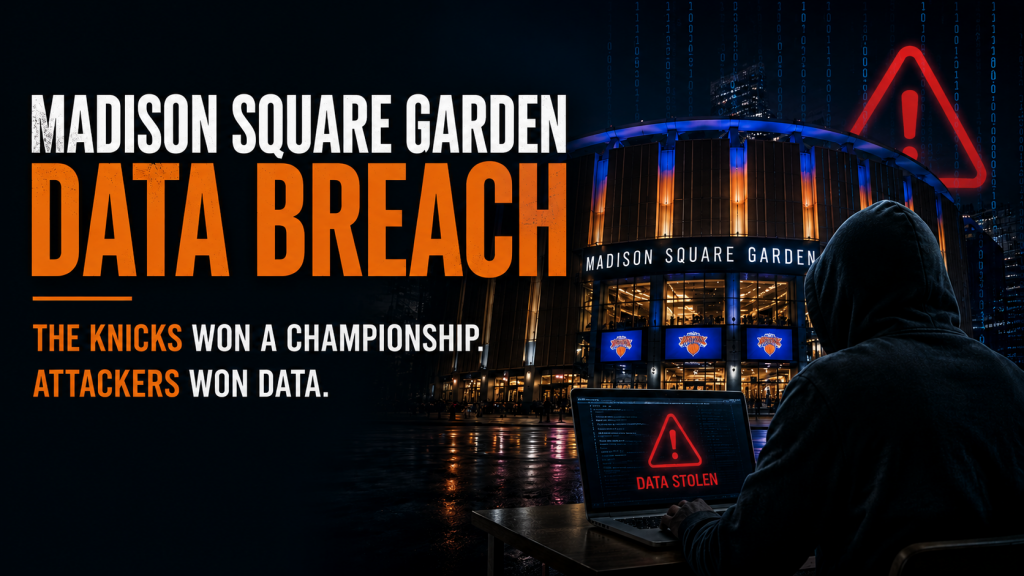
While the New York Knicks were celebrating their first championship in decades, another story was unfolding behind the scenes; one involving stolen data, extortion, and a well-known cybercriminal group.
Reports indicate that cybercriminal group ShinyHunters published a significant amount of data associated with Madison Square Garden after ransom demands were reportedly not met.
For cybersecurity professionals, the story isn't really about basketball.
It's about a growing trend that business leaders should be paying attention to.
Why ShinyHunters Matters
Many business leaders have never heard of ShinyHunters.
Security professionals have.
The group has been linked to numerous high-profile breaches affecting organizations across retail, technology, entertainment, education, and financial services.
What makes this year particularly noteworthy is the volume and visibility of incidents attributed to the group. Security researchers have described 2026 as one of ShinyHunters' most active and destructive periods, with multiple major organizations reportedly impacted by large-scale data theft and extortion campaigns.
Their approach reflects a broader shift in cybercrime.
Rather than focusing solely on operational disruption, groups like ShinyHunters are increasingly targeting valuable data, public exposure, reputational damage, and business pressure.
In many cases, the goal is not simply to gain access.
The goal is to create leverage.
Data Has Become the Leverage
Traditional ransomware attacks focused on disrupting operations.
Systems were encrypted.
Files became inaccessible.
Organizations were pressured to pay to regain access.
Today's cybercriminals increasingly follow a different playbook.
They steal the data first.
Then they use that information as leverage.
If an organization refuses to pay, the data may be published, sold, or used to create additional pressure.
The damage no longer depends solely on whether systems remain online.
It depends on what information was exposed and how it can be used.
That's a very different risk conversation than many organizations were having just a few years ago.
Not All Sensitive Data Looks Sensitive
One of the more interesting aspects of the reported Madison Square Garden incident is the variety of information that was allegedly exposed.
According to reporting, the leaked data reportedly included customer information, employee records, internal communications, operational documents, vendor-related information, and files connected to celebrities, executives, and other high-profile individuals.
Reports also referenced information tied to security operations, surveillance-related programs, and internal risk classifications.
Viewed individually, some of these records may not appear particularly sensitive.
Combined, however, they can provide attackers with a detailed understanding of how an organization operates, who has access to critical systems, how decisions are made, and where future attacks may be most effective.
This is one of the reasons modern data theft incidents can be so damaging.
The value isn't always found in a single file or database.
It's often found in the broader picture attackers can assemble from thousands of seemingly unrelated records.
A Different Leadership Question
When organizations review incidents like this, the first question is often:
"How did they get in?"
That's important.
But there may be a more valuable question:
"What could an attacker access if they did?"
Many breaches become far more damaging because organizations underestimate the value of the information stored inside operational systems.
The issue isn't always the initial compromise.
It's the amount of data available after that compromise occurs.
What Business Leaders Should Consider
Events like this are a reminder to evaluate:
- What sensitive information is being retained?
- Who has access to it?
- How long is it being stored?
- Are access permissions reviewed regularly?
- Would you know if large volumes of data were being exfiltrated?
- Have you identified systems that contain operational intelligence, not just regulated data?
Because attackers are no longer focused solely on disrupting operations.
Increasingly, they're focused on extracting information.
A Leadership Reflection
The lesson from the Madison Square Garden incident isn't about sports.
It's about recognizing how cyber risk continues to evolve.
The organizations that will be most resilient are not necessarily the ones with the most security tools.
They're the ones that understand what data they have, why it matters, and how to limit exposure before an attacker discovers its value for them.